How to Choose the Right Frozen Meat Dicing Machine for Your Business?
Dicing meat by hand is slow, inconsistent, and expensive at scale. A frozen meat dicing machine solves these problems in one step, cutting fresh, chilled, or semi-frozen meat into uniform cubes, strips, or slices. For meat processing plants, central kitchens, and food factories, choosing the right model is the difference between a smart investment and an expensive mistake.
This guide walks you through the key decisions, using the Taizy QD-350 and QD-550 frozen meat dicing machine models as a practical reference. Follow these steps to select a machine that matches your product, output, and facility.

What Does a Frozen Meat Dicing Machine Do?
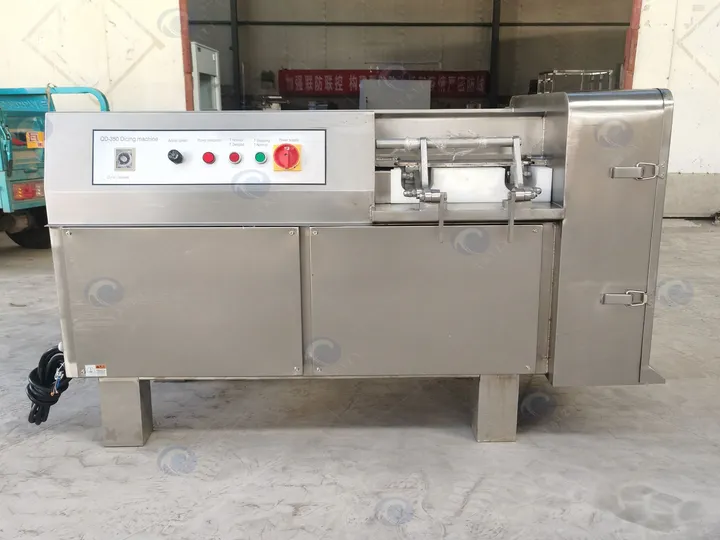
A frozen meat dicing machine uses a three-dimensional blade system to cut meat in one pass. The horizontal and vertical blade sets work together, so the product comes out as uniform cubes with no debris and a clean surface. Unlike a standard meat slicer, a dicer does not need pre-cutting. Whole meat blocks enter through a large feeding inlet and come out as finished cubes.
The Taizy machines handle fresh, chilled, or semi-frozen meat from -8°C to 0°C up to room temperature. They process pork, beef, chicken, and duck, and can also cut cheese. Cutting thickness is adjustable from 3 to 30 mm, and cube size can be customized between 5 and 28 mm.

Step 1: How Much Processing Capacity Do You Need?
Capacity comes first. The Taizy range offers two output levels:
| Modelo | Saída | Max Charging Length | Cutting Groove | Potência | Dimensões | Peso |
|---|---|---|---|---|---|---|
| QD-350 | 300–400 kg/h | 350 mm | 84×84×350 mm | 2,25 kW | 1500×760×970 mm | 400 kg |
| QD-550 | 500–600 kg/h | 550 mm | 120×120×550 mm | 3.3 kW | 1920×1000×10 40 mm | 600 kg |
Match the machine to your daily target. If you dice 2,000 kg per day, the QD-550 finishes the job in roughly four production hours. If your volume is under 1,500 kg per day, the QD-350 is the more economical choice. Always leave 15 to 20 percent extra capacity for order growth.
Step 2: What Temperature Should the Meat Be Before Dicing?
This point is often overlooked. A true frozen meat dicing machine is designed for meat at -8°C to 0°C, which is semi-frozen, not fully frozen solid. Meat at this temperature cuts cleanly and holds its cube shape. Fully frozen meat below -10°C stresses the blades and motor. Fresh meat above 5°C can smear and lose definition.
Before buying, confirm your workflow: can you keep meat in the right temperature range before dicing? If your raw material arrives deep-frozen, plan a tempering step in a chiller or thawing room.
Step 3: Which Meat Cube Sizes Do You Need?
Different products need different cube dimensions. Kebab suppliers often need 2 to 3 cm cubes. Stew meat packs may use larger sizes. The Taizy machines adjust cutting thickness from 3 to 30 mm, and square block sizes from 5 to 28 mm can be customized.
Ask the supplier to confirm the available blade configurations for your target sizes before ordering. A commercial meat dicer with the wrong blade set is useless until new blades arrive.


Step 4: What Power Supply and Installation Space Are Required?
Both Taizy models run on 380V/50Hz three-phase power. Confirm your facility supply before ordering. Also measure your floor space. The QD-350 needs about 1.5 × 0.76 meters plus room for feeding and discharge. The QD-550 is larger at 1.92 × 1 meter. Allow clearance on both sides for cleaning and blade removal.
Check the floor load as well. At 400 to 600 kg, these machines need a level, solid surface.
Step 5: How Do You Evaluate Hygiene and Machine Quality?
The machine works in direct contact with raw meat, so build quality matters. Look for:
- 304 stainless steel food-contact parts
- A fully enclosed design that keeps debris inside
- Detachable blade assemblies for washing
- Smooth surfaces without dirt traps
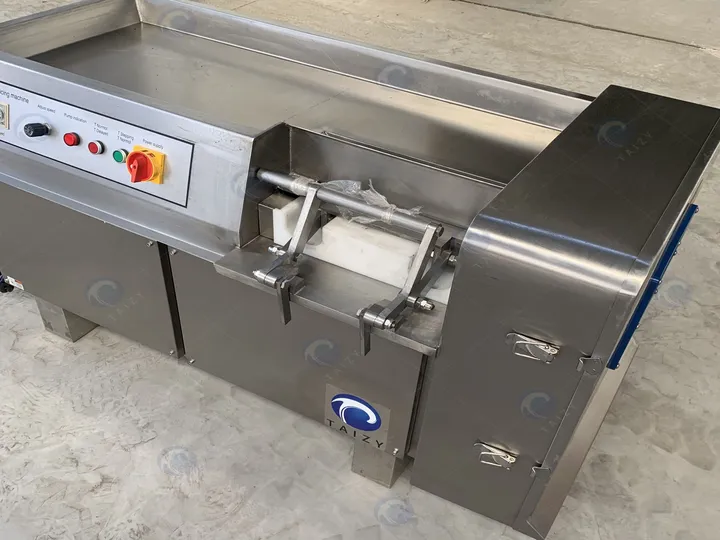
The Taizy meat cube cutting machine meets these points, and its enclosed structure supports continuous batch production with stable, low-noise operation.
Step 6: How Should You Compare Equipment Cost and After-Sales Support?
Price should never be the only factor. A cheaper machine with weak blades and no support costs more within a year. Compare:
- Machine price and shipping terms
- Blade availability and replacement cost
- Warranty length, 12 months as standard
- English manuals, videos, and remote technical support
- Spare parts delivery time
A reliable supplier answers technical questions before the sale, not only after payment.
What Common Mistakes Should You Avoid When Choosing a Machine?
Avoid these errors when selecting a frozen meat dicing machine:
- Buying by capacity claims alone. Real output depends on meat temperature, feeding speed, and cube size.
- Ignoring voltage. Most industrial dicers need 380V three-phase power.
- Skipping the temperature check. Meat that is too hard or too soft ruins cut quality.
- Forgetting blade spares. Blades wear. Order spare sets with the machine.
- No plan for cleaning. Daily blade washing is mandatory for food safety.
How to Choose the Right Máquina de Corte de Carne Congelada for Your Business?
Choosing the right frozen meat dicing machine comes down to six factors: capacity, meat temperature, cutting size, power and space, hygiene construction, and supplier support. The Taizy QD-350 and QD-550 cover 300 to 600 kg/h with adjustable 3 to 30 mm cutting, one-pass three-dimensional cutting, and stainless steel construction, fitting everything from central kitchens to large processing plants.
Define your daily output and cube size first. Then request a quotation with blade options and a layout check. A well-matched commercial meat dicer pays for itself quickly through labor savings, uniform product quality, and higher yield.
Contact us today for model recommendations, blade configurations, and a detailed quotation tailored to your production target.