How to Choose the Right Frozen Meat Dicing Machine for Your Business?
Dicing meat by hand is slow, inconsistent, and expensive at scale. A frozen meat dicing machine solves these problems in one step, cutting fresh, chilled, or semi-frozen meat into uniform cubes, strips, or slices. For meat processing plants, central kitchens, and food factories, choosing the right model is the difference between a smart investment and an expensive mistake.
This guide walks you through the key decisions, using the Taizy QD-350 and QD-550 frozen meat dicing machine models as a practical reference. Follow these steps to select a machine that matches your product, output, and facility.

What Does a Frozen Meat Dicing Machine Do?
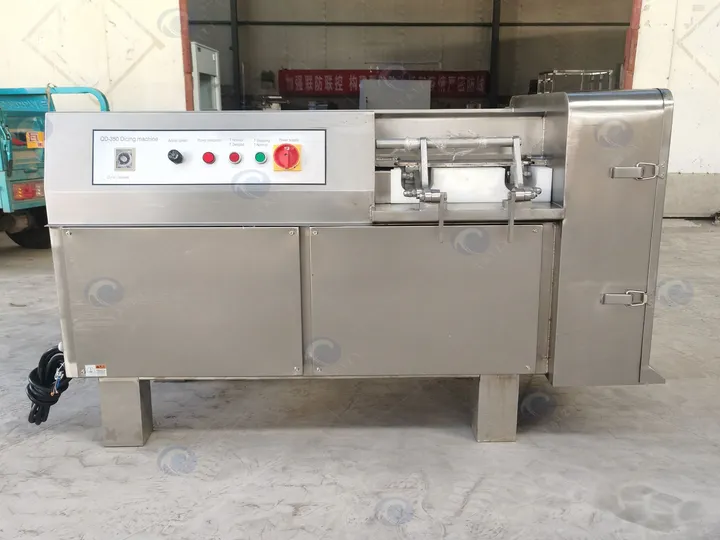
A frozen meat dicing machine uses a three-dimensional blade system to cut meat in one pass. The horizontal and vertical blade sets work together, so the product comes out as uniform cubes with no debris and a clean surface. Unlike a standard meat slicer, a dicer does not need pre-cutting. Whole meat blocks enter through a large feeding inlet and come out as finished cubes.
The Taizy machines handle fresh, chilled, or semi-frozen meat from -8°C to 0°C up to room temperature. They process pork, beef, chicken, and duck, and can also cut cheese. Cutting thickness is adjustable from 3 to 30 mm, and cube size can be customized between 5 and 28 mm.

Step 1: How Much Processing Capacity Do You Need?
Capacity comes first. The Taizy range offers two output levels:
| Modèle | Sortie | Max Charging Length | Cutting Groove | Puissance | Dimensions | Poids |
|---|---|---|---|---|---|---|
| QD-350 | 300–400 kg/h | 350 mm | 84×84×350 mm | 2,25 kW | 1500×760×970 mm | 400 kg |
| QD-550 | 500–600 kg/h | 550 mm | 120×120×550 mm | 3.3 kW | 1920×1000×10 40 mm | 600 kg |
Match the machine to your daily target. If you dice 2,000 kg per day, the QD-550 finishes the job in roughly four production hours. If your volume is under 1,500 kg per day, the QD-350 is the more economical choice. Always leave 15 to 20 percent extra capacity for order growth.
Step 2: What Temperature Should the Meat Be Before Dicing?
This point is often overlooked. A true frozen meat dicing machine is designed for meat at -8°C to 0°C, which is semi-frozen, not fully frozen solid. Meat at this temperature cuts cleanly and holds its cube shape. Fully frozen meat below -10°C stresses the blades and motor. Fresh meat above 5°C can smear and lose definition.
Before buying, confirm your workflow: can you keep meat in the right temperature range before dicing? If your raw material arrives deep-frozen, plan a tempering step in a chiller or thawing room.
Step 3: Which Meat Cube Sizes Do You Need?
Different products need different cube dimensions. Kebab suppliers often need 2 to 3 cm cubes. Stew meat packs may use larger sizes. The Taizy machines adjust cutting thickness from 3 to 30 mm, and square block sizes from 5 to 28 mm can be customized.
Ask the supplier to confirm the available blade configurations for your target sizes before ordering. A commercial meat dicer with the wrong blade set is useless until new blades arrive.


Step 4: What Power Supply and Installation Space Are Required?
Both Taizy models run on 380V/50Hz three-phase power. Confirm your facility supply before ordering. Also measure your floor space. The QD-350 needs about 1.5 × 0.76 meters plus room for feeding and discharge. The QD-550 is larger at 1.92 × 1 meter. Allow clearance on both sides for cleaning and blade removal.
Check the floor load as well. At 400 to 600 kg, these machines need a level, solid surface.
Step 5: How Do You Evaluate Hygiene and Machine Quality?
The machine works in direct contact with raw meat, so build quality matters. Look for:
- 304 stainless steel food-contact parts
- A fully enclosed design that keeps debris inside
- Detachable blade assemblies for washing
- Smooth surfaces without dirt traps
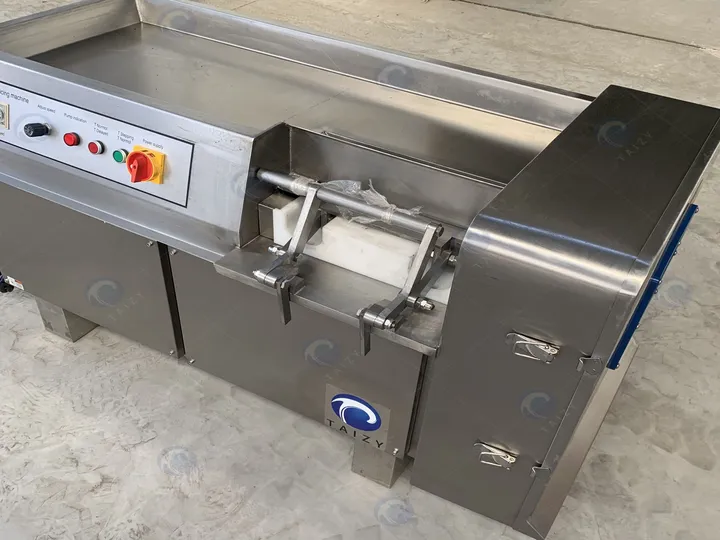
The Taizy meat cube cutting machine meets these points, and its enclosed structure supports continuous batch production with stable, low-noise operation.
Step 6: How Should You Compare Equipment Cost and After-Sales Support?
Price should never be the only factor. A cheaper machine with weak blades and no support costs more within a year. Compare:
- Machine price and shipping terms
- Blade availability and replacement cost
- Warranty length, 12 months as standard
- English manuals, videos, and remote technical support
- Spare parts delivery time
A reliable supplier answers technical questions before the sale, not only after payment.
What Common Mistakes Should You Avoid When Choosing a Machine?
Avoid these errors when selecting a frozen meat dicing machine:
- Buying by capacity claims alone. Real output depends on meat temperature, feeding speed, and cube size.
- Ignoring voltage. Most industrial dicers need 380V three-phase power.
- Skipping the temperature check. Meat that is too hard or too soft ruins cut quality.
- Forgetting blade spares. Blades wear. Order spare sets with the machine.
- No plan for cleaning. Daily blade washing is mandatory for food safety.
How to Choose the Right Machine à couper la viande congelée for Your Business?
Choosing the right frozen meat dicing machine comes down to six factors: capacity, meat temperature, cutting size, power and space, hygiene construction, and supplier support. The Taizy QD-350 and QD-550 cover 300 to 600 kg/h with adjustable 3 to 30 mm cutting, one-pass three-dimensional cutting, and stainless steel construction, fitting everything from central kitchens to large processing plants.
Define your daily output and cube size first. Then request a quotation with blade options and a layout check. A well-matched commercial meat dicer pays for itself quickly through labor savings, uniform product quality, and higher yield.
Contact us today for model recommendations, blade configurations, and a detailed quotation tailored to your production target.